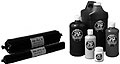
| Manufacturing Commercial Explosive Simulants XM Commercial Simulants mimic explosives commonly used in mining, quarrying
and civil construction. There are simulants for Dynamite and for three
generic emulsion/water gel-type explosives (Low, Medium and High Z explosives).
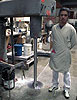
These simulants are prepared in the large Cowles dissolver normally
used for manufacturing paints. See Figure
4. Manufacturing Melt-Cast Explosive Simulants XM produces three simulants for the high energy melt-cast explosives
TNT, Tritonal and Comp B. These simulants are produced in the same mixing
equipment as the commercial explosive simulants but at higher temperature
(70C to 90C). A wax-like material is first melted and solids with the
desired density and atomic number are added at temperature with mixing
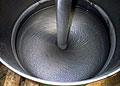
until uniform. Figure
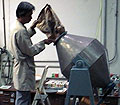
6 shows the molten TNT simulant being mixed. Manufacturing Gun Powder Simulants XM makes simulants for both Black and Smokeless powder. Solids with the appropriate densities and atomic numbers are mixed in the large powder blender shown in Figure 8. A simulant for the granular explosive ANFO (ammonium nitrate/fuel oil) is also made in this blender. Conclusion Large scale production equipment used for making artist’s clays
and paints has proven to be ideally suited for preparing a suite of
explosive X-ray simulants. Over five thousand pounds of these materials
have been produced during the past few years. These X-ray simulants
are now being used extensively in the testing of equipment and training
of personnel at numerous airports. |
|
|
|
 Fig. 8 (click to enlarge) |
|
 Fig. 9 (click to enlarge) |
|